
You can access both of our platforms from a single Saxo account.

Oracle: three option strategies for three market views

Summary: Oracle has fallen 58% from its September 2025 peak while its revenue kept growing. Here are three option structures for three different readings of that gap, and what the options chain says about which side of the trade is being paid.
A stock can halve and still be the same company, or it can become a different one. Options offer defined-risk ways to express that view, but the outcome still depends on expiry timing and time decay, not just being right about the company.
Oracle (ORCL) closed at $137.30 on 30 September 2026, down roughly 58% from its all-time-high close of $328.33 on 10 September 2025 (Source: Saxo platform, as of 30 September 2026 close). Past performance is not indicative of future results. The business grew over the same period: fiscal 2026 revenue was $67.36bn, up 17.35%, with fiscal 2027 guided to around $90bn (Source: Oracle Q4 FY2026 results, investor.oracle.com). In our view, the de-rating appears to reflect questions about how the AI buildout is financed more than any weakness in the top line.
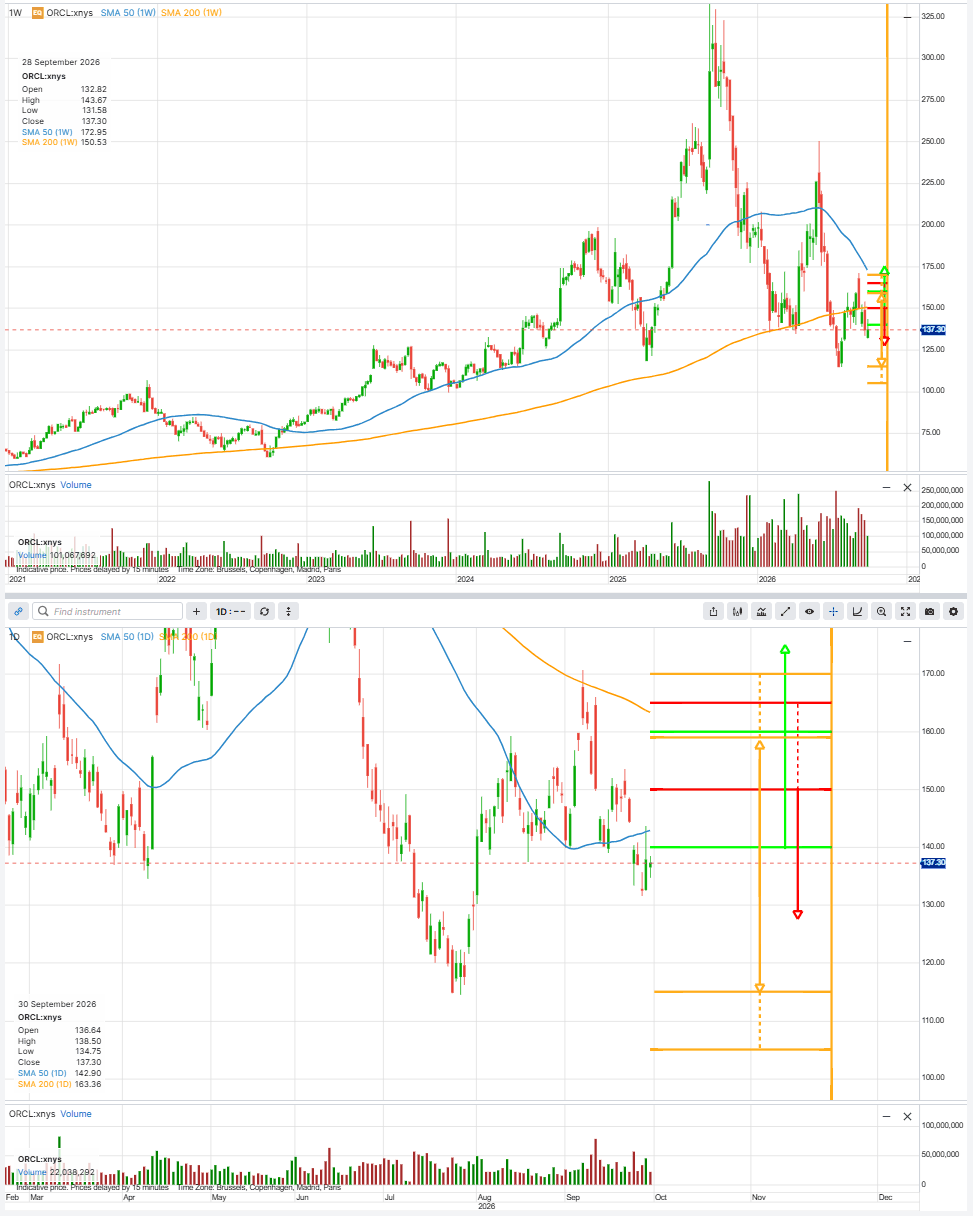 Oracle weekly and daily price action, showing the fall from the September 2025 peak and the strike levels used in the three structures below. Past performance is not a reliable indicator of future results. This chart is illustrative and for educational purposes only; it is not predictive. Source: SaxoTrader
For traders considering the event, the key question is whether the risk/reward justifies a position at all and, if so, how to structure it with defined risk. That starts with what the options market is charging – and on Oracle it is charging something slightly unusual. Implied volatility is high in absolute terms at roughly 53%, but unremarkable against Oracle’s own history – IV rank 28.6, IV percentile 39.3 – and it sits almost exactly on 21-day realised volatility of 53.1% (Source: Saxo platform, as of 1 October 2026). More telling, the skew leans to the upside: at the 20 November 2026 expiry the 25-delta call trades about 2.9 volatility points above the 25-delta put, widening to 5.0 points at 10-delta (Source: Saxo platform, as of 1 October 2026).
So selling options here is not obviously selling expensive volatility, and if a trader does want to sell premium, in our view the chain appears to favour the call side rather than the put side. That is the reverse of the usual pattern in a stock that has just fallen hard. Options carry a high risk of rapid loss and are not suitable for every investor.
Important note: The strategies and examples provided in this article are purely for educational purposes. They are intended to assist in shaping your thought process and should not be replicated or implemented without careful consideration. Every investor or trader must conduct their own due diligence and take into account their unique financial situation, risk tolerance, and investment objectives before making any decisions. Remember, investing in the stock market carries risk, and it’s crucial to make informed decisions.
All examples use the 20 November 2026 expiry, a Friday, which falls before Oracle’s next results – the fiscal Q2 2027 reporting date is unconfirmed and expected in December 2026. Premiums are mid prices from the Saxo chain snapshot at the 30 September 2026 close and would need repricing before any entry. See Saxo pricing for costs and applicable charges.
Bullish view: the de-rating has overshot
The bullish case is that the market has repriced a financing question as though it were a demand question. A trader holding this view wants upside exposure, but buying a call outright means paying a 53% implied volatility for it. A vertical spread addresses that. Note too that December implied volatility sits about 5 points above November, because December contains the earnings event – which makes a calendar or diagonal unattractive here, since it would buy the dearer leg and sell the cheaper one.
Example structure (illustrative only – not a trade recommendation)
- Buy 1 ORCL 20 November 2026 $140 call (mid about $9.73)
- Sell 1 ORCL 20 November 2026 $160 call (mid about $4.08)
- Net debit: approximately $5.65 = $9.73 paid for the long call, less $4.08 taken in on the short call
- Maximum risk: approximately $565 per spread, being the net debit paid
- Maximum profit: approximately $1,435 per spread, being the $20 width less the $5.65 debit
- Break-even at expiry: approximately $145.65, a rise of 6.1% from $137.30
This structure may profit if Oracle rises above $145.65 by expiry, with the maximum gain at or above $160; the maximum loss is the $565 debit, incurred at or below $140. These figures are hypothetical, for education only. Costs and charges apply to each leg; see Saxo pricing for full details.
Strategy insight – the short leg does more than cut the cost. An outright $140 call would cost nearly $973 and need a move above $149.73 to break even. Selling the $160 call cuts the break-even by just over $4 and, thanks to the upside skew, the call sold carries a higher implied volatility (54.9%) than the one bought (52.7%). The trade-off is a hard ceiling: everything above $160 belongs to the buyer of that short call.
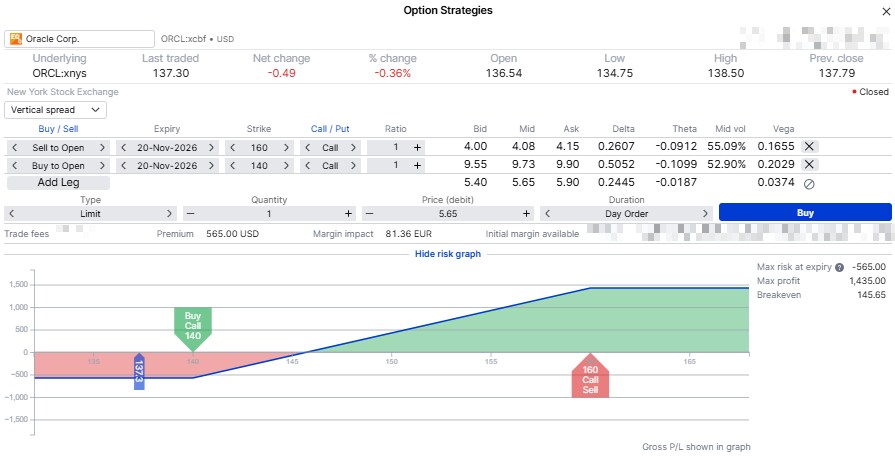 Payoff at expiry for the 140/160 bull call spread. Illustrative only – not a trade recommendation. Past performance is not a reliable indicator of future results; this chart is illustrative and not predictive. Source: SaxoTrader
Bearish view: the financing question is not resolved
The bearish case is that nothing has yet answered the question the market is asking about how the buildout is financed. A trader holding this view could consider buying puts – but in our view the skew may argue against it. Downside puts do not appear to be bid relative to equivalent calls here: the 25-delta put trades at 52.2% implied volatility against 55.1% for the 25-delta call (Source: Saxo platform, as of 1 October 2026). Selling a call spread can be read as expressing the same caution, and it collects the richer premium instead of paying for it.
Example structure (illustrative only – not a trade recommendation)
- Sell 1 ORCL 20 November 2026 $150 call (mid about $6.35)
- Buy 1 ORCL 20 November 2026 $165 call (mid about $3.28)
- Net credit: approximately $3.07 = $6.35 taken in on the short call, less $3.28 paid for the long call
- Maximum profit: approximately $307 per spread, being the net credit received
- Maximum risk: approximately $1,193 per spread, being the $15 width less the $3.07 credit
- Break-even at expiry: approximately $153.07, a rise of 11.5% from $137.30
This structure may keep the full $307 credit if Oracle closes at or below $150 at expiry, and reaches its maximum loss of $1,193 at or above $165 – a risk close to four times the reward, which is the price of a structure that profits from the stock simply not rallying. These figures are hypothetical, for education only. Costs and charges apply to each leg; see Saxo pricing for full details.
Strategy insight – a bearish trade that does not need the stock to fall. This is the structural appeal of a call spread over a put: it profits if the stock falls, stays flat, or rises modestly. What it cannot survive is a sharp recovery. Note also that the long $165 call is bought at a higher implied volatility (55.6%) than the $150 call is sold at (53.8%) – skew cuts both ways, depending on which leg is being bought.
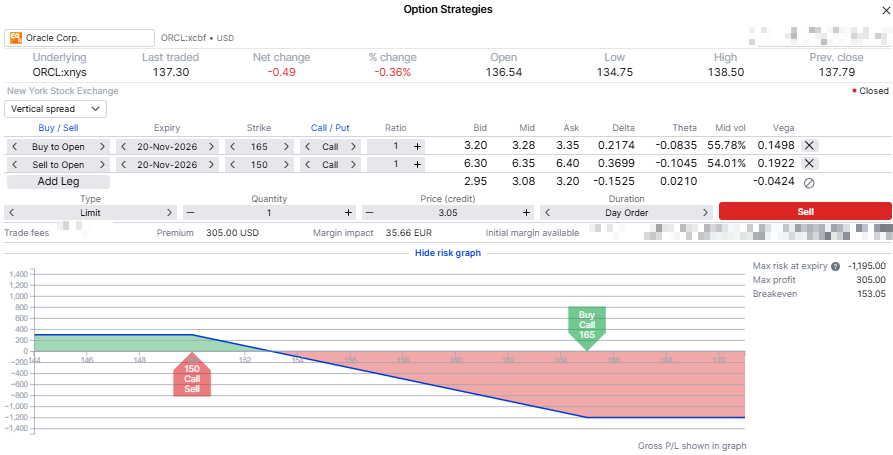 Payoff at expiry for the 150/165 bear call spread. Illustrative only – not a trade recommendation. Past performance is not a reliable indicator of future results; this chart is illustrative and not predictive. Source: SaxoTrader
Range-bound view: nothing resolves before December
The third view is that both of the above are premature: the question driving Oracle’s de-rating is about cash flows over years, and that the next real information may arrive with December’s results. An iron condor can be used to express this. It sells a put spread below the market and a call spread above it, and profits if the stock stays between the short strikes.
Example structure (illustrative only – not a trade recommendation)
- Sell 1 ORCL 20 November 2026 $115 put (mid about $2.37)
- Buy 1 ORCL 20 November 2026 $105 put (mid about $1.01)
- Sell 1 ORCL 20 November 2026 $160 call (mid about $4.08)
- Buy 1 ORCL 20 November 2026 $170 call (mid about $2.61)
- Net credit: approximately $2.83 = $1.36 from the put side ($2.37 less $1.01) plus $1.47 from the call side ($4.08 less $2.61)
- Maximum profit: approximately $283, being the net credit received
- Maximum risk: approximately $717, being the $10 wing width less the $2.83 credit
- Break-even at expiry: approximately $112.17 on the downside and $162.83 on the upside
Because both wings are $10 wide, the maximum loss is one wing’s width less the credit, not the sum of both – only one side can finish in the money. This structure may retain the full $283 credit if Oracle expires between $115 and $160, and loses up to $717 beyond either long strike. These figures are hypothetical, for education only. Costs and charges apply to each leg; see Saxo pricing for full details.
Strategy insight – the expiry is the strategy. This is built on November because the results are expected in December, and in our view a condor may be a poor fit for holding through a binary event, because a large move in either direction can produce the maximum loss. Choosing an expiry that excludes the catalyst is central to how this structure is built. Future outcomes are uncertain and may result in losses. Note too that the short $160 call sits 16.5% above the current price and the short $115 put 16.2% below – almost equidistant – yet the call side pays more ($1.47 against $1.36). That is the upside skew again, showing up in the credit.
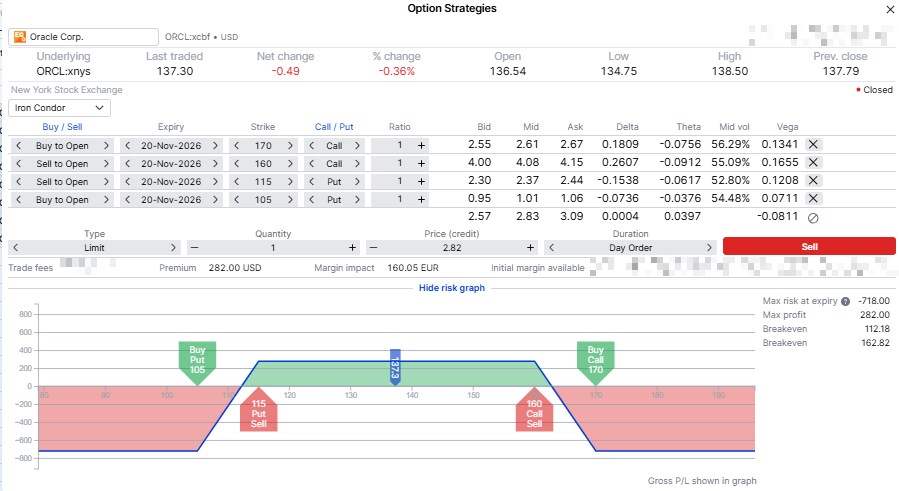 Payoff at expiry for the 105/115 – 160/170 iron condor. Illustrative only – not a trade recommendation. Past performance is not a reliable indicator of future results; this chart is illustrative and not predictive. Source: SaxoTrader
Points a trader may wish to review before any trade:
- Bid/ask spreads – the figures above use mid prices, and several of these strikes quote wide enough to change the economics at entry
- Volume and open interest at the specific strikes selected
- Whether Oracle has confirmed its December reporting date, which changes which expiries contain the event
- Implied volatility against realised volatility, currently close on Oracle
- An exit plan defined before entry, particularly for the condor
Assignment risk note: Oracle options are American-style, so short legs can be assigned before expiry if they move in the money. Oracle has declared a $0.50 quarterly dividend with a record date of 9 October 2026 (Source: Oracle Corporation dividend announcement), so an in-the-money short call is most exposed to early exercise at the close on 8 October 2026, and most of all once its remaining time value falls below $0.50. Traders may wish to understand the platform’s assignment process before entering a position.
Final thoughts
These are not three forecasts. They are three ways of being specific about a view most people hold only vaguely. “Oracle looks cheap” becomes a question of whether it clears $145.65 within seven weeks. “Nobody knows until December” becomes a defined range and a defined cost of being wrong.
The reflex after a 58% fall is to assume fear is priced into the downside and that put premium is rich; in our view, the data on Oracle may not support that reading. The view comes first, but the chain may inform how to express it. Options carry a high risk of rapid loss and are not suitable for every investor.
The author does not hold positions in any of the instruments mentioned in this article. The Author is permitted to wait at least 24 hours from the time of the publication before they trade the instruments themselves.
| Related articles/content |
|---|
| Finding unusually expensive or cheap options in the Saxo screener | 18 Sep 2026 Implied volatility rank what it measures and what it misses | 11 Sep 2026 Nine prints later what Q2 earnings season taught us | 11 Aug 2026 DRAM the memory boom now has an option chain Here is how to read it | 4 Aug 2026 What IV crush really means in practice reviewed version | 9 April 2026 Trading earnings with defined | 31 Mar 2026 The index held the average stock did not - Options Brief - 1 October 2026 |
| More from the author |
|---|