
Access all our platforms from a single account.

TLT: naming your price on long-term bonds – and being paid to wait

Summary: Anyone who has bought long-dated government bonds since 2020 has probably lost money on them. Selling a cash-secured put on TLT is a way of naming the price at which you would be willing to try again, and being paid while you wait.
With a bond fund, choosing what you pay is the same as choosing what you earn.
Long-dated government bonds have been falling since 2020. TLT, the iShares 20+ Year Treasury Bond ETF, closed at USD 78.62 on 28 September 2026, less than half its 2020 peak. The 30-year US Treasury yield closed at 5.55% and the 10-year at 5.24%, after the Federal Reserve raised its target range to 3.75–4.00% on 16 September (Source: Saxo, SaxoTraderGo and the Federal Reserve, as of 28 September 2026). Past performance is not indicative of future results.
Plenty of investors have tried to call the bottom. As my colleague Charu Chanana argued on 29 September 2026 in Bonds 101, the case for bonds now is not that yields have certainly peaked, but that higher starting yields make fixed income useful again across a wider range of portfolios. That still leaves the question of timing.
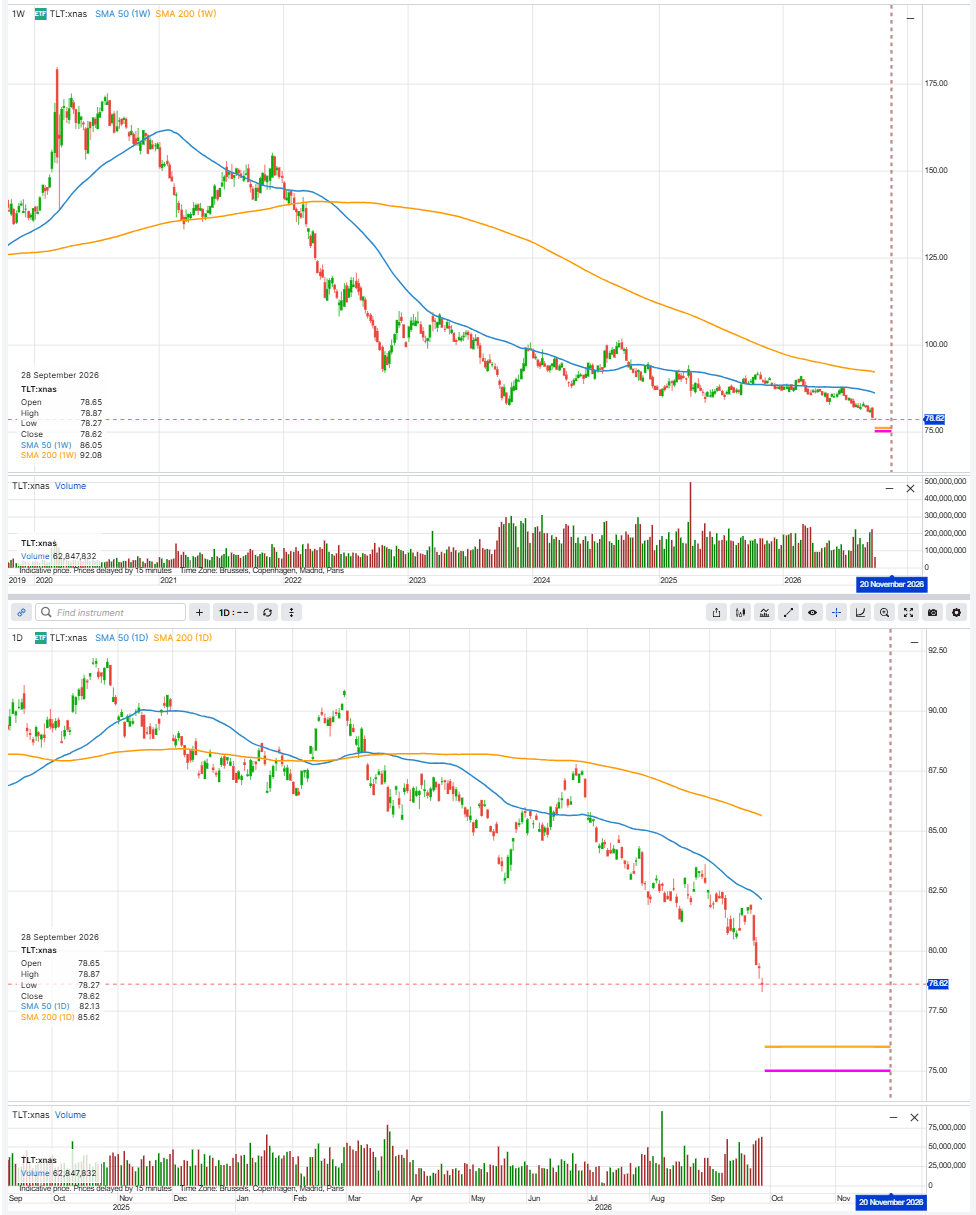 TLT weekly and daily, with the 76 and 75 strikes and the 20 November 2026 expiry marked. Illustrative and educational, not predictive. Past performance is not indicative of future results. Source: SaxoTraderGo, indicative prices, as of 28 September 2026.
Why TLT falls when yields rise
TLT does not hold shares. It holds loans to the US government – the long ones, with more than twenty years still to run.
A bond is a fixed deal. You lend, you collect a set amount of interest each year, and you get your money back on a set date. None of that ever changes. What changes is what your loan is worth if you want to sell it to somebody else in the meantime.
Imagine you lent the government money for thirty years back in 2020, when it paid less than 2% a year to borrow (Source: US Treasury, 30-year yield, as of 2020). Today it pays around 5%. Nobody will take your low-rate loan off your hands at full price when they can lend at 5% instead. They will only take it at a discount – and a big one, because they would be stuck with the low rate for another twenty-five years. The government will still repay you in full on the date it promised. Your loan is simply worth less to anyone else in the meantime.
TLT is full of those loans. That is why it has fallen so far: not because anything went wrong, but because the fund is holding money lent out cheaply, and it has been marked down to compete with what is on offer today (Source: iShares, as of 25 September 2026). Past performance is not indicative of future results.
The flip side is the part worth keeping hold of. A lower price and a better rate of return are the same thing seen from two directions.
Important note: The strategies and examples provided in this article are purely for educational purposes. They are intended to assist in shaping your thought process and should not be replicated or implemented without careful consideration. Every investor or trader must conduct their own due diligence and take into account their unique financial situation, risk tolerance, and investment objectives before making any decisions. Remember, investing in the stock market carries risk, and it’s crucial to make informed decisions.
Naming your price
That is what makes TLT different from a share. When a company’s shares fall, something has usually changed about the company. When TLT falls, it mostly means lenders are demanding more to lend long-term – so naming a price at which an investor would buy is the same as naming a rate at which they would be willing to lend to the US government for twenty years or more.
Today’s price is one offer. A few percent lower would be a better one. The investor who wants to own long bonds but thinks today’s price is not quite enough is really saying: I would lend, but not at that rate. An option is a way of saying so out loud, and being paid for it.
Selling a cash-secured put means agreeing to buy 100 shares at the strike if TLT falls there by expiry, in exchange for a premium collected today. Theta – time decay – works for the seller.
Sellers appear well paid at the moment. Implied volatility on TLT options was around 15.4%, higher than on all but three of the past 252 trading days, against 11.6% actually realised over the previous month (Source: Saxo, as of 28 September 2026). In our view that may say less about opportunity than about how far the market thinks bonds could still fall. Options carry a high risk of rapid loss and are not suitable for every investor.
If the intention is to own it: the 76 strike
Hypothetical, for education only – not advice or a trade recommendation.
Example structure (illustrative only – not a trade recommendation)
- Sell 1 TLT 20 November 2026 76 put for a credit of 0.98, with TLT at USD 78.33
- Premium received: USD 98, against USD 7,600 of cash set aside
- Delta: −0.31, a rough guide to the chance of assignment
- Purchase price if assigned: USD 75.02, about 4.2% below the price at the time
- Maximum profit: USD 98; maximum loss: USD 7,502, if TLT fell to zero
- (Source: SaxoTraderGo, as of 29 September 2026, 16:31 CET)
Risk: the USD 98 is the whole upside however far bonds rally, and as a cushion it is worth about 1.25% of the share price – below USD 75.02 the loss grows dollar for dollar, as it would for a shareholder. Options carry a high risk of rapid loss and are not suitable for every investor. Costs apply per contract; see Saxo pricing.
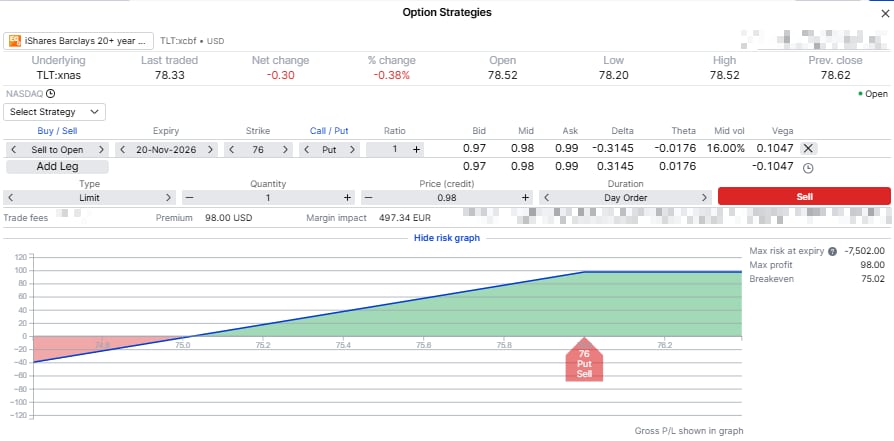 The 76 put in the option strategies ticket, with the platform’s own risk graph and its max risk, max profit and break-even. Hypothetical, for education only. Past performance is not indicative of future results; figures are illustrative and not predictive. Source: SaxoTraderGo, as of 29 September 2026.
If the intention is the premium: the 75 strike
Hypothetical, for education only – not advice or a trade recommendation.
Example structure (illustrative only – not a trade recommendation)
- Sell 1 TLT 20 November 2026 75 put for a credit of 0.72, with TLT at USD 78.34
- Premium received: USD 72, against USD 7,500 of cash set aside
- Delta: −0.25, a rough guide to the chance of assignment
- Purchase price if assigned: USD 74.28, about 5.2% below the price at the time
- Maximum profit: USD 72; maximum loss: USD 7,428, if TLT fell to zero
- (Source: SaxoTraderGo, as of 29 September 2026, 16:33 CET)
Risk: standing a point further back buys an extra point of room and a better price if it happens, but cuts the premium by more than a quarter, so the cushion shrinks too – and being wrong still means carrying the full fall below USD 74.28. Options carry a high risk of rapid loss and are not suitable for every investor. Costs apply per contract; see Saxo pricing.
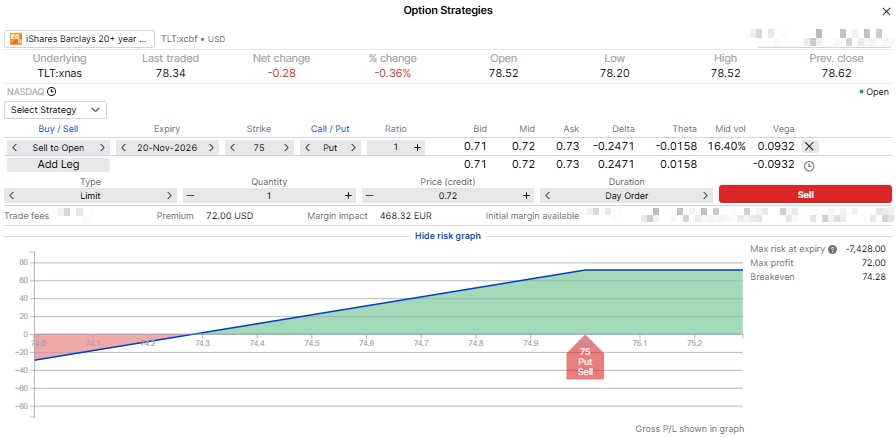 The 75 put in the option strategies ticket. Hypothetical, for education only. Past performance is not indicative of future results; figures are illustrative and not predictive. Source: SaxoTraderGo, as of 29 September 2026.
Before placing the trade, check:
- Bid and ask spreads, and open interest at the strike
- The expiry: 20 November and 18 December 2026 are both standard monthlies
- The monthly distribution. TLT’s price drops by it on the ex-date, and the option is not adjusted (Source: iShares, as of 25 September 2026)
- Commission. It is charged per contract and weighs more heavily on a small premium than a large one, so check what applies to your own account (Source: Saxo listed options commissions)
- Whether the cash is genuinely set aside. The ticket above shows a margin impact of roughly EUR 470–500, not the full USD 7,500 (Source: SaxoTraderGo, as of 29 September 2026) – “cash-secured” is a discipline the investor applies, not something the platform enforces
- An exit plan
Assignment risk note: TLT options are American-style, so a short put can be assigned before expiry if it moves in the money, particularly near expiration or around the ex-dividend date. Only the seller of an option faces assignment risk.
Final thoughts
One difference is worth stating plainly. A bond has a maturity date, so an investor who holds it gets repaid in full eventually. A bond fund does not. TLT keeps replacing its holdings as they age, so there is no date on which the position comes good by itself. Someone assigned at 76 and still holding two years later is relying on yields falling, not on time passing.
What the structure does is replace a forecast with a condition. Instead of deciding whether yields have peaked, an investor decides at what price long bonds are worth owning, and is paid for committing cash to that answer. In our view it may suit someone who wants to own long bonds but distrusts their own timing, and it suits nobody who does not want to own TLT at all. Options carry a high risk of rapid loss and are not suitable for every investor.
The author does not hold positions in any of the instruments mentioned in this article. The Author is permitted to wait at least 24 hours from the time of the publication before they trade the instruments themselves.
| More from the author |
|---|